

Across boardrooms worldwide, leaders are racing to integrate AI into day-to-day work to drive efficiency. But efficiency improves the old; it doesn’t create the new. Real progress lies in defining something that hasn’t been done before: reimagining how people lead, learn and create alongside intelligent technology. To truly harness agentic AI, organisations must move beyond optimisation toward innovation and, ultimately, reinvention.
Learning about AI is a three-loop journey:
- Optimisation: Using AI to make existing work faster and smarter
- Innovation: Discovering entirely new ways to work and create
- Reinvention: Redefining what work looks like in an AI-powered world
Most organisations are still mastering the first loop. But loops two and three are where the real transformation happens – when we rethink how people learn, lead and define career growth.
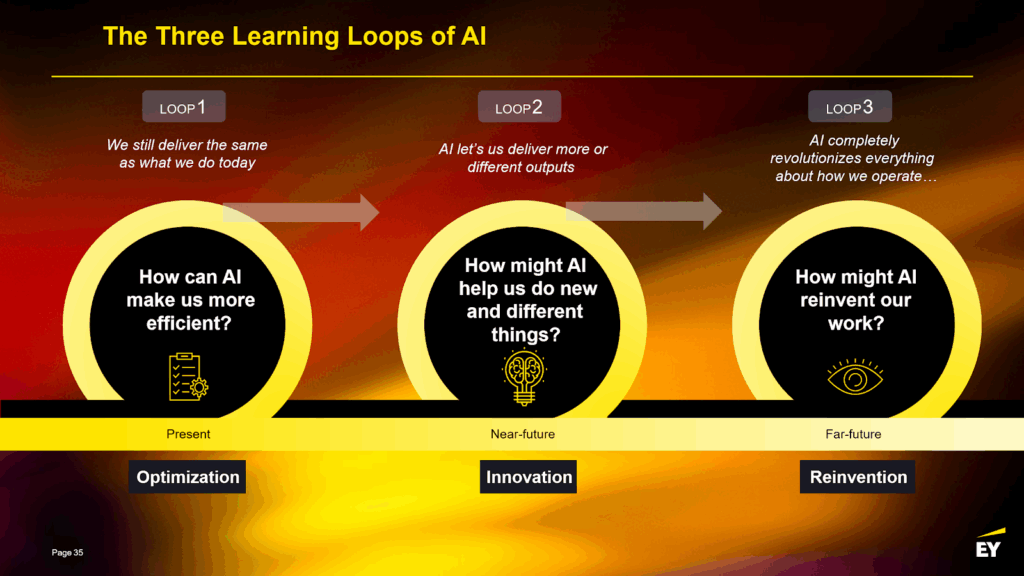
The innovation loop is about experimenting and learning what we can do differently with AI that we couldn’t do before. For example, training humans to build and manage agents to achieve new possibilities and better outcomes.
Reinvention considers what the world looks like when everyone is using AI and we have a hybrid workforce of humans and agents. That’s when we can ask: What do we need to learn to operate differently – how do we reinvent ourselves, our business models and our organisations?
Some of the most forward-thinking organisations are already learning, experimenting and adapting in real time, pushing towards these second and third loops.
Here are some of the learning trends we’re seeing and steps we’re taking at EY to move beyond optimisation to reimagine leadership and productivity in the face of human-AI collaboration.
Building a culture of continuous and collaborative learning
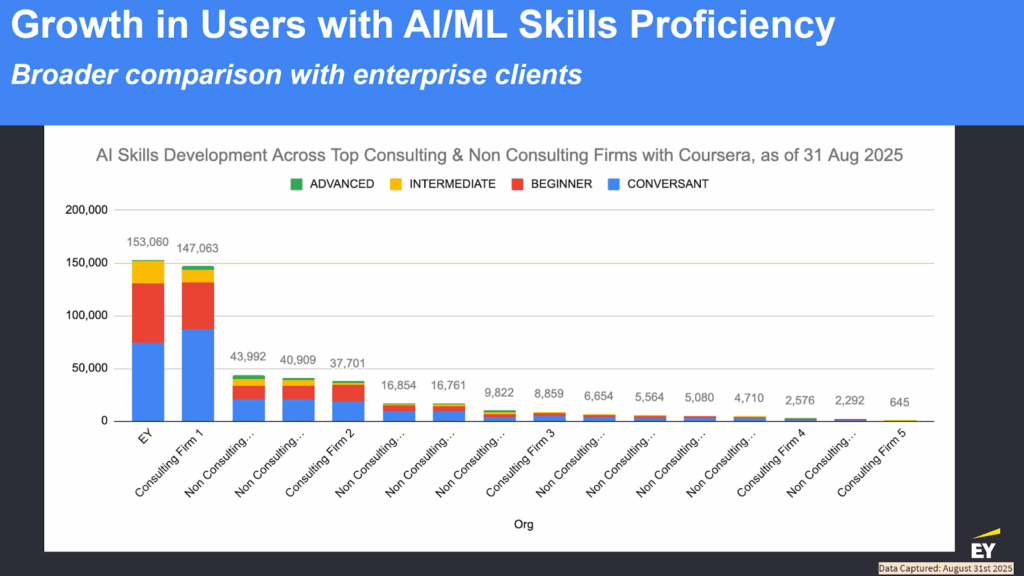
Offering AI learning at scale is the quickest way to enact meaningful change. At EY, our EY Badges program offers more than 250 digital courses to help our employees build future-focused skills, including AI Engineering, Applied AI, Responsible AI, and more recently, Agentic AI. Already, more than 175,000 new AI Badges have been initiated or awarded as people build new confidence and competencies.
Training completions are just one metric. A more meaningful one is skills acquisition. External benchmarking can help organisations understand how quickly their people are developing AI capabilities compared to their peers and industry standards.
Having a flexible AI learning approach helps employees receive diverse and engaging experiences that cater to different needs and interests while building their required skills.
Focusing on career agility and the emergence of new roles
AI is supporting greater career agility. Instead of static roles and traditional career paths, people can now pursue a wider range of opportunities and take on new challenges.
As AI technology supports us in building skills and performing in our roles, career personalisation becomes much more possible. AI can increasingly understand users’ skills and development needs, so they can receive customised coaching (from human or AI coaches), learning and new opportunities to grow.
Early AI conversations revealed a trust gap characterised by uncertainty and job insecurity. But agentic AI is shifting that narrative. By involving people from the ground up, organisations are creating a greater sense of ownership, control, and excitement.
Already, we’re seeing new roles emerge. For example, organisations are focusing on the work required to train and assess agents. And, as AI technology processes and cleans up vast amounts of data that organisations have never had access to before, they’re carving out product manager roles to provide the oversight and human judgment required to put this data to use in driving new value.
Evolving leadership expectations
Leading organisations aren’t just thinking about the transition to working with agents. They’re thinking about how to create a culture where that’s an expectation and part of the day-to-day.
For many, that transition will require a reset or refresh of leadership behaviors. At EY, we recently revisited what’s expected from leaders in an AI-powered world. The result is our “All in Leadership Expectations”, which detail the importance of embracing AI to elevate thinking, creativity and impact.
The framework is tied to key performance indicators. This approach helps encourage curiosity and continuous learning, while also creating a psychologically safe environment where people can experiment and innovate.
Fostering partnerships to experiment in real time
Innovation and reinvention as the second and third loops of AI learning require continuous refinement. They also necessitate a solid foundation of responsible AI practices.
To facilitate this kind of environment, many organisations are forging partnerships to unite their complementary strengths. At EY, a partnership with Microsoft Copilot helps teams and clients strike the right balance between human judgment and technological capability. This kind of real-time experimentation and adaptation is no longer optional – it’s become a core leadership and organisational imperative.
Offering contextualised learning where people can test their skills in real-life scenarios is also important. EY Future Hack is part learning event, part hackathon. Our fall event gathered 170 global participants for a two-week, comprehensive training in partnership with Microsoft Copilot on how to build agents and identify use cases – testing them in real time.
Everyday AI learning
While no one knows exactly what the future looks like, organisations can shape it by embedding AI into the everyday. That means continuously learning and experimenting, rethinking processes and career frameworks, and developing new roles. It also means working out how to manage agents like employees – training them, improving their performance, and ensuring they are working in the right roles.
Thoughtfully moving beyond optimising what we do today to reinventing for the future will allow us to smoothly integrate AI and unlock new opportunities.
Reinvention starts with learning to navigate the new, leading boldly, and daring to imagine what comes next.
Simon is the Global Learning & Development Leader at EY, international best-selling author of “The Curious Advantage” and co-host of the popular podcast, The Curious Advantage. He is a regular keynote speaker at international events on the topics of learning, leadership and transformation – including the role and vast potential of AI.