

Modern professionals consume information differently than they did even five years ago, shaped by platforms like TikTok and Instagram Reels to expect valuable content delivered quickly and accessibly. Yet most L&D strategies lack ultra-short, focused options that fit the micro-moments throughout a professional’s day.
Nano learning fills this gap. As industry analyst Josh Bersin observes, ‘The modern learner is overwhelmed, distracted, and impatient – they won’t sit through an hour of training.’ It’s not about replacing comprehensive training or structured courses—it’s about expanding your learning toolkit with a format specifically designed for today’s time-pressured workforce.”
This guide explores what nanolearning means for L&D teams, why it works so effectively alongside other learning formats, and how to implement it in your organisation to provide employees with professional development that fits every available moment.
What is nano learning and what does it mean for L&D?
Nano learning delivers upskilling content in ultra-short experiences – typically between just 1 and five minutes – with each piece addressing a single, specific learning objective.
These aren’t truncated versions of longer courses. Nano content for learning is purpose-built to deliver complete, immediately applicable knowledge in micro-moments.
It represents an additional format option within the workplace learning ecosystem. Whilst traditional training programmes (30-60 minutes) and microlearning (10-15 minutes) continue to serve important purposes, nano learning (under 5 minutes, as brief as 60 seconds) addresses a specific need: providing accessible professional development in the brief moments employees have available throughout their day.
What makes it distinctive isn’t just duration, it’s the strategic design around single learning objectives delivered through engaging, self-contained experiences.
A two-minute video on active listening should leave learners with one actionable skill they can apply in their next conversation, not a theoretical framework they’ll forget by lunchtime.
Nano learning delivers upskilling content in ultra-short experiences
How does nano learning fit within your learning ecosystem?
Understanding when to use nanolearning versus other formats helps L&D teams build comprehensive learning strategies rather than forcing one approach to serve all purposes. A robust learning ecosystem leverages multiple formats strategically, with each serving specific learning objectives and contexts.
Traditional eLearning vs microlearning vs nanolearning
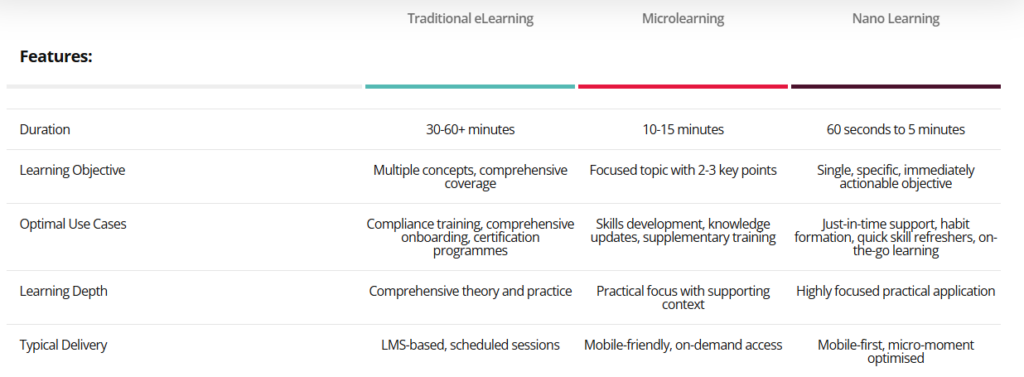
These formats aren’t mutually exclusive, they’re complementary. Comprehensive compliance training might still require traditional eLearning, whilst ongoing professional development benefits enormously from the accessibility of nano content.
The strategic question isn’t which format to choose exclusively, but rather which format best serves your employees’ needs and learning preferences for different types of development.
Why is nano learning transforming professional development?
This method of learning addresses specific operational challenges L&D teams face whilst aligning with how modern professionals actually consume information. Here’s how it solves persistent workplace learning problems:
Extensive content libraries address diverse needs
Rather than creating a small selection of longer, in-depth training resources that may only be relevant to specific roles, this format of earning enables organisations to provide vast libraries of short content.
Employees simply choose the topics highly relevant to them, ensuring every team member finds value regardless of their role, experience level, or immediate challenges.
Accessibility drives engagement
Busy professionals struggle to find time for longer learning formats during their working day. This short format means employees can actually consume upskilling content in the micro-moments they have available, between meetings, during commutes, or in brief breaks, without sacrificing productive work time or requiring dedicated learning session
Providing just-in-time skill support
Employees often need specific guidance when facing unfamiliar situations, preparing for a difficult conversation or leading their first team meeting.
Nanolearning provides immediate access to relevant techniques in the flow of work, right when they’re needed.
Maintaining content freshness
The modular nature means updates affect individual content resources rather than entire programmes.
When new content is required for emerging needs or trends, standalone modules can be added quickly, keeping libraries current whilst reducing the ongoing maintenance burden for resource-constrained L&D teams.
How can you apply nano learning in your organisation?
The versatility of this content format means it works across virtually every professional development area and fits naturally into the flow of work. Let’s explore where it delivers the most impact and how employees can access it throughout their day.
Why video-based nano learning works best
Video-based nano content succeeds because it aligns with how professionals across all generations consume information in their personal lives—though familiarity varies by age group.
Platforms like TikTok, Instagram Reels, and YouTube Shorts have fundamentally shifted expectations around content delivery, particularly for Millennials and Gen Z who represent the current workforce majority.
With Generation Alpha entering the workforce from 2028 onwards, having never known a world without smartphones, these expectations will intensify. However, the effectiveness of the nano format isn’t limited to younger generations.
When organisations provide the right content and clearly communicate its benefits, professionals of all ages find value in brief, focused video that delivers practical skills they can apply immediately.
Video delivers information efficiently. According to Forrester Research, employees are 75% more likely to watch a video than to read documents, emails or web articles, and video content is processed 60,000 times faster than text. Busy professionals across all career stages appreciate learning that respects their limited time whilst delivering genuine value.
Expert-led video builds credibility. Watching subject matter experts demonstrate techniques or explain a topic creates connection and trust that text struggles to match. These aren’t corporate marketing videos—they’re authentic practitioners sharing their knowledge. Engagement soars when employees understand they’re accessing credible industry expertise.
Mobile video enables learning on the go. Video-based nano content fits the micro-moments throughout any professional’s day—commuting, travelling between meetings, or brief breaks. This capability transforms previously unproductive time into valuable development opportunities.
Effective video formats for nanos include expert-led demonstrations where subject matter experts share real-world insights, short instructional videos showing step-by-step techniques, and scenario-based videos that help bridge learning to performance by showing how skills apply in actual workplace situations.
The versatility of this content format means it works across virtually every professional development area
What professional development areas work best for nano learning?
Nano learning excels across virtually every professional development area. Here’s how different skill categories translate into impactful experiences:
Leadership and management skills work brilliantly in focused formats. Employees access precise guidance on specific challenges—motivating team members, delegating effectively, or providing feedback. A five-minute module on one technique proves more valuable than hour-long courses covering everything.
Communication and presentation is a natural fit. Modules demonstrating specific techniques—structuring openings, handling questions, or adapting styles—provide tangible skills employees can practice immediately.
Personal productivity and wellbeing benefit from brief, accessible formats employees can return to regularly. Time management, stress techniques, or mindfulness practices build better as consistent brief practices than occasional workshops.
Technical skills including AI and Microsoft Office transform through nano learning. Digestible content snippets on AI prompt engineering, Excel functions, or Teams features deliver immediately applicable efficiency gains.
Sales, marketing and HR professionals gain targeted just-in-time guidance. Objection handling, needs identification, recruitment practices, or engagement strategies become practical tools rather than theoretical frameworks.
When and where should employees access nano learning?
The accessibility of the nano format fundamentally changes how professional development fits into work life.
Self-directed browsing happens during brief periods—before meetings or at day’s end. A well-designed platform lets employees explore content that genuinely interests them, improving engagement because people invest more in learning they’ve chosen.
Search for specific skills addresses just-in-time needs. When facing a challenge, employees find precisely the guidance they need right now, transforming learning into practical support.
Saved playlists let employees build personalised development paths aligned with their goals. This personal library grows into a curated resource reflecting each employee’s unique journey.
On-the-go opportunities during commutes, between meetings, or in brief breaks turn previously unproductive time into valuable development. This suits video-based content that delivers complete learning experiences without requiring sustained concentration.
The key insight: nanolearning fits around work rather than interrupting it. Employees can access upskilling resources exactly when they need them, making professional development sustainable rather than aspirational.
How do you drive adoption and engagement with nano learning?
Driving adoption requires addressing both organisational and individual factors and crucially, educating employees about what nano content is and how it benefits them.
Communicate the value clearly. Many employees across all generations may not be familiar with nanolearning as a format. Clear communication about what it offers— focused, expert-led guidance they can access in five minutes or less when they need it or fancy it — helps drive adoption. Explain that this isn’t replacing their existing learning opportunities; it’s adding a valuable format that fits the micro-moments throughout their day. When employees understand the practical benefits, adoption spans all age groups and experience levels.
Secure leadership buy-in by emphasising productivity enhancement rather than training compliance. Five minutes spent on communication techniques before a crucial meeting delivers more value than an hour-long course completed months ago and forgotten. This just-in-time support resonates with results-focused executives.
Let quality drive engagement. Employees who access nano content and find genuinely helpful, immediately applicable skills become advocates who recommend specific resourcess to colleagues. This organic peer-to-peer promotion proves far more effective than top-down mandates. The engaging nature of video-based nano content particularly supports sharing and social learning.
Position as supplement, not replacement. Nano learning works best as continuous self-directed upskilling available alongside mandatory training. An organisation that adopts nano content resources is expanding workforce development opportunities by providing growth-focused learning that employees genuinely want.
Communicate specific use cases. Rather than “check out our new platform,” highlight particular scenarios: “Need to use AI tools more effectively? These five nano videos will help you master prompt engineering and output validation” or “Client presentations making you nervous? Access this short video on confidence-building techniques right before your next pitch.”